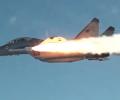
The Directors General of Military Operations of India and Pakistan firmed up the arrangement on stopping military actions on May 10 after four days of fierce offensives between the two sides that triggered fears of a wider conflict.

The Chinese military on Monday started new major drills in the 'middle areas' of the Taiwan Strait amid rising diplomatic tensions with Japan over Taiwan that Beijing claims as its territory.

Union ministers paid tribute to the victims of the Pahalgam terror attack on its first anniversary, reaffirming India's commitment to combating terrorism with a firm and zero-tolerance policy.
The Congress party has criticised the Modi government on the first anniversary of the Pahalgam terror attack, stating that Pakistan has gained global respectability due to the failure of Prime Minister Narendra Modi's foreign policy.

Donald Trump's inconsistent statements and actions regarding the conflict with Iran have drawn criticism and confusion, raising questions about American credibility and the direction of US foreign policy.

Pakistani security forces killed at least 13 terrorists along the Afghanistan border in Khyber Pakhtunkhwa province during operations in Mohmand and North Waziristan districts.

The United States has redirected 48 vessels in the Persian Gulf, particularly in the Strait of Hormuz, over the past 20 days amid ongoing enforcement actions related to restrictions on Iranian maritime assets by the US Navy.
China has called on Iran to reopen the Strait of Hormuz and expressed appreciation for Tehran's commitment not to develop nuclear weapons, a key demand of the US to end the conflict.

The Congress party in India has expressed "grave concern" over the US action in Venezuela, stating that settled principles of international law cannot be violated unilaterally. India has also voiced "deep concern" and called for a peaceful resolution through dialogue.

While Trump described the operation as the 'most daring' search and rescue mission in US military history, Iran termed it a victory, claiming it shot down a C-130-class aircraft involved in the operation.

'Neither do the Israelis. The two attacking parties have very little economic interest in Hormuz.'

...is a way out, notes Prem Panicker in his must read blog on the Iran War. What the indefinite extension produces is a prolonged condition of not-war-not-peace, in which oil markets cannot stabilise, Asian refineries cannot plan, European governments cannot stop subsidising consumption they cannot afford, and the next flashpoint -- a seized tanker, a miscalculated drone strike, a Truth Social post that claims too much -- is one news cycle away.
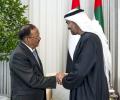
India is the only significant power that all parties trust, or at least do not distrust, notes former defence secretary Ajay Kumar.

Donald Trump has issued a stern warning to Iran, stating that the US will take a tougher stance if a diplomatic resolution regarding its nuclear programme is not reached soon.
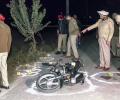
The investigation into the Patiala freight corridor blast has led to the seizure of a large cache of munitions and explosives and the uncovering of a deep-rooted terror conspiracy involving Pakistan-backed ISI and pro-Khalistan terrorists, Punjab police said.

Sri Lanka has established emergency hotlines and is closely monitoring the situation in West Asia following escalating tensions, urging restraint and de-escalation from all parties involved.

Sri Lanka's response to the Easter attacks has been slow and politically contested, unlike India's swift institutional reforms after the 2008 Mumbai terror attacks, observes Colonel R Hariharan (retd).

Russia and China on Saturday condemned the United States airstrikes on Venezuela and the capture of its president, Nicolas Maduro and his wife.

Under Operation Sindoor, Indian armed forces not only struck Pakistani military bases near the border but their might was even felt in Rawalpindi where the headquarters of the Pakistani Army is located, Defence Minister Rajnath Singh said on Sunday.
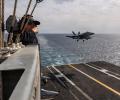
While Trump has been examining the possibility of stationing ground forces in the Middle East, CBS News reported that he has yet to define the exact conditions under which he would approve their use.

India said it is closely monitoring the evolving situation in Venezuela and reaffirmed its support for the well-being of people of the country.

'As result, Netanyahu 'convinced' Trump to go to war with the help of overoptimistic Israeli intelligence assessments, essentially explaining to him that they only need to bomb Iran for 3-4 days, and the regime would then collapse.' 'Rather unsurprisingly, Netanyahu is ever since blaming his own intel service for the entire operation failing.'

India summoned the Iranian envoy after two Indian vessels had to reverse course in the Strait of Hormuz following an incident of firing by Iran's Revolutionary Guards.

Pezeshkian urged American citizens to look beyond 'manufactured narratives', claiming the portrayal of Iran as a threat is driven by the military-industrial complex and Israeli political interests.

The United States' historical strategic alignment with Pakistan, dating back to the Cold War, has consistently aimed to create a political and military parity with India, despite India's significantly larger size and resources. This long-standing relationship continues to influence regional dynamics, particularly in West Asia and the Indo-Pacific.

Amid escalating tensions with Iran, President Trump is urging nations dependent on Middle Eastern oil to deploy warships to the Strait of Hormuz to safeguard critical global energy supplies.
The US blockade on Iranian ports is aimed to curb Iranian energy exports, thereby crippling its economy to force Iran back to the negotiating table, points out Commodore Venugopal Menon (retd).

Admiral Alireza Tangsiri was accused of leading efforts to disrupt maritime trade, including actions affecting the Strait of Hormuz.

The Iranian Foreign Ministry has stated that Tehran currently has no plans for a subsequent round of negotiations with the United States, according to the state media Tasnim news agency. This announcement comes as international mediators had hoped for a follow-up to the Islamabad talks before the looming ceasefire deadline.

Romance and action rule the roost on this week's OTT special. Take your pick from Sukanya Verma's eclectic menu.

The authorities confirmed that the security situation in the UAE remains stable and that all concerned entities are monitoring developments around the clock.

Speaking to reporters aboard Air Force One, Trump said the US prefers a negotiated settlement and expects cooperation from Iran on securing nuclear-related materials.

Iran has formally appealed to the United Nations Security Council and the UN Secretary-General, accusing the United States of inciting violence, interfering in Iran's internal affairs, and threatening military action, according to an official letter circulated by Iran's Permanent Mission to the UN.

US President Donald Trump has announced plans to clear the Strait of Hormuz to secure the vital oil corridor, citing risks to global energy supplies and criticising other nations' inaction.

Amidst ongoing conflict, Iranian President Masoud Pezeshkian signals a potential de-escalation by apologising to neighbouring countries while firmly rejecting US President Donald Trump's demand for unconditional surrender.

The United States has warned China against escalating tensions as Taiwan detected multiple Chinese naval vessels, official ships and balloons operating around the island amid Beijing's large-scale live-fire military drills.

Economist Jeffrey Sachs saw Gulf nations' decision to partner with the US through the Abraham Accords as an "invitation for disaster" as it made them more dependent on American protection.

The Dhurandhar movies will undoubtedly shape the minds of the audience much more than news reports, court investigations, books and documentaries. But it is worth remembering that Pakistan's irridentist claims against India's national security have succeeded due to strategic planning, diplomacy, and the unsung heroines and heroes across government agencies, not due to a single maverick leader, points out Shweta Desai.But it is worth to remember that Pakistan's irredentist claims against India's national security have succeeded due to strategic planning, diplomacy, and the unsung heroines and heroes across government agencies -- not a single maverick, points out Shweta Desai.

Iran has lodged a formal complaint with the United Nations, accusing the US of engaging in 'piracy' following the seizure of Iranian vessels. The complaint was detailed in a letter sent by Iran's UN envoy to the UN Secretary-General and the Security Council.

The Indian Air Force's Republic Day flypast will feature a 'Sindoor' formation of combat jets, symbolizing its dominance during recent hostilities. The flypast will also commemorate Operation Sindoor.
